Once Again on the Path of Francis…
Come, let us journey with the Church in the light of the Gospel…
As printed in the magazine
Read as text
The same article as plain text: easier to read on a phone, to search, to copy or to translate.
Eight hundred years ago, in the hills of Umbria in Italy, a young man took off his father's costly clothes and laid them at the feet of the Bishop of Assisi. "Until now I have called Pietro di Bernardone my father," he said. "From now on I will say only, 'Our Father, who art in heaven.'" The townspeople were astonished; some laughed. But in that moment a new chapter in the history of the Church began.
That young man was Francis. Today, on the 800th anniversary of his death, we invite you to set out once more on the path he walked — a journey made not with the feet but with the heart. Every place is a lesson, and every lesson is an invitation for our own lives.
"Francis, go and repair my house, which is falling into ruin."
— The voice from the San Damiano Cross
First Stop: Assisi — City of Dreams
Francis was born in Assisi in 1181 or 1182. His father, Pietro di Bernardone, was a prosperous cloth merchant; his mother, Pica, was gentle and devout. At baptism he was named Giovanni, but his father, who loved France, began calling him "Francesco" — "the little Frenchman." The name stuck.
As a young man Francis was the life of every party: songs, music, friends and fine clothes were his world. He dreamed of glory and longed to become a knight. In 1202 he fought in the battle of Collestrada against neighbouring Perugia, was captured, and spent about a year as a prisoner.
"Lord, what do you want me to do?"
— the prayer of the young Francis
When he rose from a long illness, he was no longer the same. The pleasures of the world tasted of nothing. Setting out once more for war, he heard a voice in a dream at Spoleto: "Is it better to serve the master or the servant?" He turned back to Assisi — not as a knight, but as a seeker.
Second Stop: San Damiano
Below Assisi, among the olive trees, stood a small, crumbling church — San Damiano. As Francis knelt in prayer before its Byzantine- style crucifix, he heard a voice: "Francis, go and repair my house, which, as you see, is falling into ruin."
At first he took the words literally. He carried stones and rebuilt the walls. In time he understood that God was asking not only for a building of stone but for a Church of living stones — one that must return to the simplicity of the Gospel.
Third Stop: Embracing the Leper
One day, riding his horse, Francis met a leper on the road. His first instinct was to turn away in disgust, but in a moment his heart changed. He dismounted, gave the man a coin and kissed his hand. Years later he wrote in his Testament: "When I was in sin, it seemed very bitter to me to see lepers. And the Lord himself led me among them, and I showed mercy to them. And when I left them, what had seemed bitter to me was turned into sweetness of soul and body."

For Us Today
What is "falling into ruin" in our families and parishes? The call to repair still echoes.
The Pilgrim Route: Nine Stops
1209/10 — ◆ Fourth Stop: The Portiuncula
On the plain below Assisi stood a tiny chapel called the Portiuncula — "the little portion" — which Francis also restored. In 1208 the Gospel read there at Mass changed his life completely: "Take no gold, nor silver, nor copper in your belts… no bag for the journey, nor two tunics" (Mt 10:9-10). "This is what I have been looking for!" he cried. He took off his sandals, tied a cord round his waist and began to live the Gospel.
Fifth Stop: The First Brothers
Bernard of Quintavalle, a wealthy man of Assisi, was the first to join him; then Peter Catani, a lawyer, and Giles, a man of simple heart. "The Lord gave me brothers," Francis later wrote, "and no one showed me what I should do, but the Most High himself revealed to me that I should live according to the form of the holy Gospel."
When the little group had grown to twelve, they went to Rome to ask Pope Innocent III to approve their simple way of life. They called themselves the "Lesser Brothers" — Friars Minor — not above anyone, but beneath all.
- Assisi (1181)
Birthplace; the start of conversion - San Damiano (1205)
The call of the Cross; later Clare's home - Portiuncula (1208)
'The little portion' — motherhouse of the Order - Rivotorto
Simple hut of the first brothers - Rome
Pope Innocent III approves the way of life - Gubbio
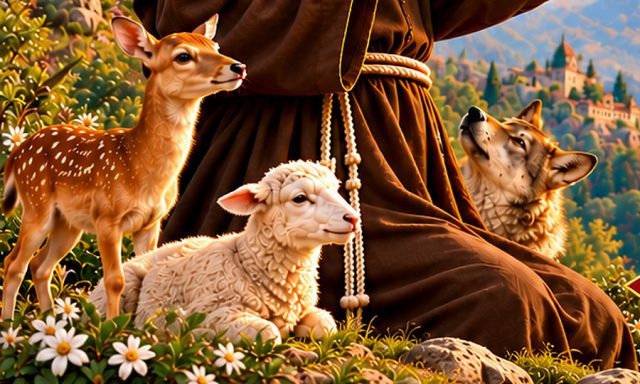
Peace with the wolf (a cherished legend) - Greccio (1223)
The first Christmas crib - La Verna (1224)
The mountain of the stigmata - Portiuncula (1226)
Where he welcomed Sister Death
* Stops in historical order; dates are approximate.

A Pilgrim's Tip
You don't need to travel to Assisi to make this journey. Take one "stop" each week, read its story, and live it through one small act.
From La Verna to the Portiuncula
In the last years of his life Francis grew physically weak and his eyes failed. Yet his heart still blazed. In September 1224, around the feast of the Exaltation of the Holy Cross, while fasting and praying on Mount La Verna, he received in his own body the wounds of the crucified Christ, as his early biographers testify. It is the summit of love: to become like the one you love.
In 1225, while Clare and her sisters cared for him at San Damiano, he composed the "Canticle of the Creatures" amid great pain. The man who lay in darkness sang of light; the man in agony sang praise. You can read the full canticle on page 24.
On the evening of 3 October 1226 he asked to be carried to the Portiuncula. He asked to be stripped and laid on the bare earth — to return to God as poor as he was born. The brothers read from the thirteenth chapter of John's Gospel, and he died singing Psalm 142. That night, tradition says, a flock of larks gathered over the roof, singing.
How Can We Walk His Path Today?
Following Francis isn't only about wearing a religious habit. Parents, students, workers and the elderly — everyone can walk in his footsteps. Here are five:
Eight hundred years ago a young man of Assisi said "yes," and the world changed. What will our "yes" change today? Let the journey begin.

- Pick up the Gospel: read a passage each day and carry one line with you.
- Choose simplicity: buy less than you can; share more than you need to.
- Seek those on the margins: visit someone who is lonely this week.
- Honour creation: plant a tree; don't waste water or power.
- Be an instrument of peace: take the first step in a broken relationship.
"I have done what is mine to do; may Christ teach you what is yours."
— last words of Francis, as recorded by St Bonaventure