As printed in the magazine
Read as text
The same article as plain text: easier to read on a phone, to search, to copy or to translate.
His life lasted only forty-four or forty-five years. Yet in that short span Francis shook the Church and society of Europe. He wrote no great books, built no vast institutions and ruled no lands. He had only one thing — an unquenchable thirst to live the Gospel to the letter.
His life falls naturally into three parts: the years of searching (1181–1205), the years of the Gospel (1206–1220) and the years united with the Cross (1221–1226). Over the next pages we follow that journey step by step.
"Brothers, let us begin, for up to now we have done little or nothing."
— words of Francis, as recorded by St Bonaventure
Part 1: Searching and the Gospel (1181–1212)
1181/82 — Born in Assisi
Son of the cloth merchant Pietro di Bernardone and his wife Pica; baptised Giovanni.
1202 — War and Prison
Captured at the battle of Collestrada against Perugia; spends about a year in prison.
1204 — Illness and Searching
A long illness after his release. Worldly pleasures lose their taste; deeper questions arise.
1205 — The Dream at Spoleto
A dream turns him back from war to Assisi. He embraces a leper.
1205/06 — The Voice of the Cross
At San Damiano: 'Repair my house.' He begins rebuilding small chapels.
1206 — Renouncing His Father
Before Bishop Guido he hands back his clothes and inheritance to his father.
1208 — The Gospel Call
Hearing Matthew 10 at the Portiuncula, he begins to live as a Gospel preacher.
1209/10 — The Order Begins
With twelve brothers he goes to Rome; Pope Innocent III gives oral approval.
1212 — Clare Arrives
On Palm Sunday night Clare consecrates herself at the Portiuncula; the 'Poor Ladies' begin.

Behind the Name
The name "Francis" spread across the world because of this son of Assisi. Today it lives on in many languages — Francis, Francisco, Francesca, François, Franziska.
"When I was in sin… the Lord himself led me among the lepers."
— The Testament of St Francis
Part 2: Toward the World, Toward the Cross (1213–1226)

Damietta: The Courage of Peace
In the middle of a war, unarmed, Francis walked into the enemy camp. The Sultan received him with courtesy, spoke with him for several days and sent him back safely, the chronicles tell us. In an age of hatred, he planted a seed of dialogue.

1217 — Mission Spreads
At the Portiuncula chapter, brothers are sent beyond Italy to many lands.
1219 — Meeting the Sultan
During the Fifth Crusade, at Damietta in Egypt, he meets Sultan al-Malik al-Kamil in peace.
1221 — The First Rule
The 'Earlier Rule' is written; a way of life for lay penitents also takes shape.
1223 — Rule Approved
On 29 November Pope Honorius III approves the final Rule with a papal bull.
1223 — The Greccio Crib
On Christmas night he creates the first living nativity in a cave at Greccio.
1224 — The Stigmata
In September, on Mount La Verna, he receives the wounds of Christ.
1225 — Canticle of the Creatures
Nearly blind, he composes the 'Canticle of Brother Sun' at San Damiano.
1226 — The Transitus
He dictates his Testament and dies at the Portiuncula on the evening of 3 October.
"May the Lord give you peace."
— the greeting with which Francis began his preaching
Four Stories from His Life
Stories of Francis have lived in people's hearts for centuries. Some come from the earliest historical sources; others were recorded later in traditional collections such as the Little Flowers of St Francis (Fioretti). In all of them one message shines: love conquers all.

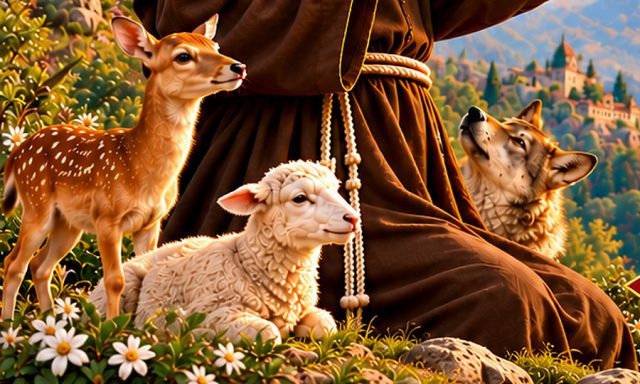
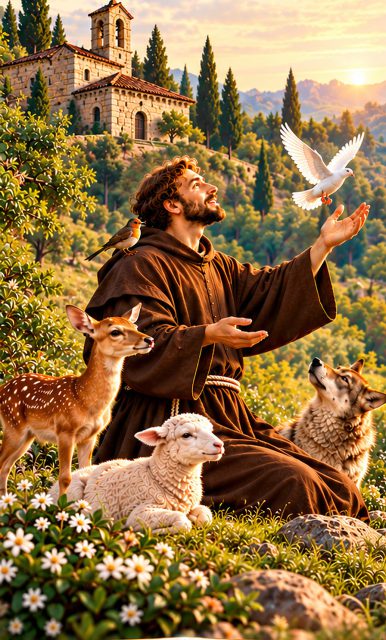
Preaching to the Birds Near Bevagna, Francis spoke to birds gathered in the trees: "My little sisters the birds, praise your Creator." According to the Little Flowers, they listened without stirring and flew off only after he blessed them.

The Wolf of Gubbio The beloved legend tells how Francis called the wolf terrorising the town "Brother Wolf" and made a pact: the people would feed it, and it would harm no one. A parable of fear overcome by dialogue.

Perfect Joy To Brother Leo he explained that perfect joy is not success or fame, but to be shut out on a freezing night, even beaten, and still bear it patiently for love of the suffering Christ.

Sister Water, Brother Fire He took care that water he washed with fell where no one would tread on it, and asked that part of the garden be left for wildflowers. Reverence for small things was his spirituality.
His Message to the World — in One Line
God is good; everything is his gift; therefore everyone — and everything — is our brother and sister. For those who truly believe this, poverty is not a burden but freedom.